Return on Investment (ROI) Analysis: How Does a Quality Machine Come Cheaper in the Long Run?
As a business owner or manager, what is the first thing you look at when buying a new machine? Most of the time our eyes instinctively go to the label at the bottom — the price. But what if we told you that you may be making your biggest mistake at exactly that moment? Because in industrial production, the true cost of a machine is not the figure you pay when buying it. The true cost is the sum of every lira that leaves your pocket, or that the machine prevents you earning, over the years it serves you.
Professional, sustainable businesses do not make decisions on a single criterion. They use two magic concepts: total cost of ownership (TCO) and return on investment (ROI). In this comprehensive analysis we work out the financial mathematics of a machine investment for you. Not with assumptions but with realistic scenarios and calculations, we will prove how a quality machine that looks 30–40% more expensive at the outset turns into an investment more than 50% more profitable over a 5-year projection. This guide is designed to win you not just a product but a profit centre on your next machine purchase.
Beyond the Label Price: Understanding Total Cost of Ownership (TCO)
A machine's price is only the part of an iceberg visible above the water. The real danger and the real cost are hidden below the surface, in details that escape notice. Total cost of ownership (TCO) is the telescope that lets you see the whole iceberg. Let us light up these hidden costs one by one.
1. The cost of downtime: the silent killer
The largest and most merciless component of TCO is every second your machine is not working because of a breakdown. Although this cost is usually thought of as "production has stopped, we are losing money", the equation is much deeper:
Cost of downtime = (hourly lost revenue + hourly idle labour cost) × total hours of downtime
Let us take an example. In a workshop producing 2,000 TL of output an hour, suppose the hourly cost of the two operators working on that machine is also 500 TL. When the machine breaks down, the money you lose per hour is not 2,000 TL but 2,500 TL. A poor-quality machine that breaks down often, standing idle just 10 hours a month, can cost you 25,000 TL a month and 300,000 TL a year. That figure is usually higher than the price of the machine itself. A quality machine is the insurance that reduces this cost to almost zero.
2. Maintenance and repair costs
"Cheap" machines generally use lower-quality motors, weaker frames and less durable electronic components. That means more frequent maintenance and more breakdowns. What you should consider:
- Repair frequency: While a quality machine shows no major fault in its first 5 years, a poor-quality machine can start causing problems from its first year.
- Spare parts: The original spare parts of world-standard brands (such as BDS and GBC) are always available. With others you may wait weeks for a part, or never find it at all. That too is added to the cost of downtime.
3. Consumables and energy efficiency
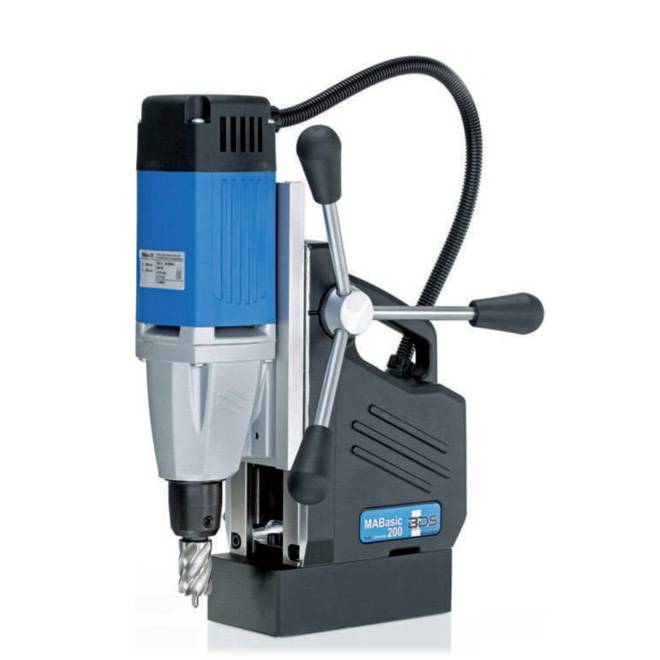
Efficiency is the key to profitability. Quality machines deliver hidden savings thanks to more efficient motors and more precise mechanical construction. For example, the slide system of a vibration-free, precise BDS magnetic drill can extend the life of the cutter by 25–30%. Over a year in which you use hundreds of cutters, that is a serious saving on consumables. In the same way, a modern, efficient motor can consume 10–15% less energy than a lower-quality one. These figures, which look small, combine over the years into a large saving.
4. Operator efficiency and safety
A well-designed, ergonomic machine lets the operator work faster and tire less. A machine that is simple to set up and intuitive to use shortens setting times. More importantly, the advanced safety systems of brands such as BDS minimise the risk of accidents. Remember, the legal, moral and financial burden that a single workplace accident brings to your business is heavier than even the most expensive machine.
5. Second-hand value (residual value)
Ten years on, while an unbranded machine is worth scrap, a well-maintained GBC or Reed machine still holds a significant part of its original investment value. A quality machine is an asset that holds its value.
From Cost to Profit: Calculating Return on Investment (ROI)
TCO has shown us what a machine will cost us. Now ROI will show us how much that machine will earn us. ROI is the most basic metric for measuring how efficient your investment is.
ROI (%) = (net profit from the investment / cost of the investment) × 100
Case Study: Two Different Magnetic Drill Investments (a 3-Year Projection)
Suppose a workshop doing steel construction work needs a magnetic drill to make an average of 1,000 holes a month.
- Machine A: "the cheap alternative" – price: 25,000 TL
- Machine B: "BDS professional series (Habib Makina)" – price: 40,000 TL
At first glance Machine A looks 15,000 TL more attractive. Now let us bring the TCO and ROI components into play:
1. Efficiency and labour gain:
Suppose that, thanks to BDS's greater torque and precise slide system, it is on average 20% faster per hole. Let the operator's hourly cost be 250 TL.
- Machine A: 1,000 holes × 3 minutes/hole = 3,000 minutes = 50 hours/month.
- Machine B (BDS): 1,000 holes × 2.4 minutes/hole = 2,400 minutes = 40 hours/month.
Gain: BDS saves 10 hours of labour every month. That is 2,500 TL a month and 30,000 TL a year.
2. Consumable (cutter) saving:
Suppose BDS's vibration-free construction extends cutter life by 25% and a cutter costs 200 TL.
- Machine A: needs 10 cutters a month = 2,000 TL/month.
- Machine B (BDS): needs 8 cutters a month = 1,600 TL/month.
Gain: BDS saves 400 TL a month on consumables and 4,800 TL a year.
3. The downtime difference:
Suppose Machine A breaks down twice a year for a total of 5 working days (40 hours), while BDS does not break down at all. Let the workshop's hourly lost revenue and idle labour cost be 1,000 TL.
- Machine A: 40 hours × 1,000 TL/hour = 40,000 TL a year in lost production cost.
- Machine B (BDS): 0 TL.
The financial result: who really wins after 3 years?
Now let us add up all the figures:
The total value Machine B (BDS) delivers over 3 years:
(labour gain + consumable gain + downtime cost avoided) × 3 years
(30,000 TL + 4,800 TL + 40,000 TL) × 3 = 224,400 TL
Yes, you read that correctly. The BDS, 15,000 TL more expensive at the outset, has delivered an economic benefit of 224,400 TL over its rival after 3 years. Even after deducting the initial price difference, the BDS has earned you an extra 209,400 TL. That is the power of ROI.
The Habib Makina Difference: The Assurance That Maximises Your ROI
The calculation above rested on the quality of the machine alone. When you add the Habib Makina factor to the equation, the return on your investment accelerates further. We do not just sell machines; we offer a system for maximising the profitability of your investment.
- Choosing the right machine: With 45 years of experience we prevent from the outset the mistaken investment of buying a machine that is too large or too small for your project. That is the biggest mistake that kills ROI.
- Professional operator training: Even the best machine is inefficient in the hands of an untrained operator. With the training we provide, we ensure your machine runs at maximum efficiency from day one.
- Periodic maintenance agreements: With our proactive maintenance services we almost entirely eliminate those frightening downtime costs we calculated above.
- Sole authorised distributorship: The guarantee of immediate access to original spare parts and factory-trained service protects your machine's life and its second-hand value.
Conclusion: The Smartest Investment Is an Investment in the Future
The figures do not lie. Focusing on the label price when buying an industrial machine is a short-term outlook. What sets successful, sustainable businesses apart from the rest is making smart decisions that minimise total cost of ownership and maximise return on investment.
A quality machine, a world-leading brand and a business partner with 45 years of experience standing behind it: that is not an expense but the most profitable, most solid and smartest investment you can make in your business's future.
Would you like the figures to speak for your business?
Get in touch with Habib Makina's project consultants today for a completely free, tailored preliminary TCO and ROI analysis showing how much your next machine investment could earn you. Get not just a price quotation but a profitability report for your business.
» Contact Us for a Free Investment Analysis and Profitability Report