Technical Standards in Industrial Pipe Processing and Weld Preparation: GBC SpA Solutions
In modern manufacturing — and above all in the construction of critical pressure vessels and high-alloy pipelines — preserving the thermal and mechanical structure of the material is a requirement, not a preference. GBC SpA, with its Italy-based engineering capability, develops solutions for pipe cutting and bevelling that meet world standards (ASME, AWS, DIN). This guide, prepared by the Habib Makina technical team, examines the metallurgical advantages of industrial "cold cutting" and "cold bevelling" and the GBC SpA technologies behind them.
1. Cold cutting technology and its metallurgical requirements
Cold cutting separates metal by mechanical chip removal, without ever reaching its melting point. Conventional plasma or oxy-fuel methods create a HAZ (Heat Affected Zone) at the cut. That thermal effect changes the grain structure of the metal, hardening it, lowering its corrosion resistance and raising the risk of cracking after welding (HIC — Hydrogen Induced Cracking).
GBC SpA pipe cutting machines work on a low-speed, high-torque principle that produces no heat during the operation. This is essential for preserving the corrosion characteristics of stainless steel, Inconel and duplex pipe in particular. The answer to the question so often asked in industrial searches — "Why should cold cutting be preferred when cutting stainless pipe?" — is that the metallurgical integrity of the material remains intact.
2. Clamshell machines: in-situ pipe processing
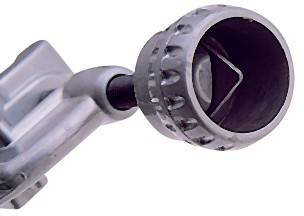
In industrial terminology, clamshell describes a portable machine whose frame splits in two (split-frame). This design allows the machine to clamp onto the outside diameter (OD) at any point along the line and work there, without needing one end of the pipe to be open. In the GBC SpA range this technology is represented by the heavy-duty GBC SUPERCUTTER and, for more compact projects, the GBC MCA series.
GBC SUPERCUTTER series: high rigidity and precision
When cutting heavy-wall pipe and bevelling it in the same pass, the GBC SUPERCUTTER stands apart for the stability of its frame. The cast aluminium alloy body keeps it portable on site, while the steel bearing systems absorb the vibration generated during the cut. Minimising vibration not only improves surface quality but also extends the service life of the cutting inserts by 40%.
GBC MCA series: an economical solution for tight spaces
On smaller-diameter pipe (1" - 6") and in projects where space is limited, the GBC MCA series delivers operational efficiency. Built on the same engineering principles as the SUPERCUTTER, the MCA is optimised, with its lighter build and lower investment cost, for refinery maintenance and shipboard pipe circuits.
3. The milling revolution in plate bevelling
In weld preparation, surface roughness (Ra) directly affects the penetration quality of the weld. The CH (Challenge) series machines used in conventional methods bevel by shearing material away. That mechanical pressure leaves microscopic cracks and a rough surface at the edge of the material.
The new-generation BASICEDGE technology
The GBC BASICEDGE series, which Habib Makina recommends for modern production lines, uses high-speed milling head technology. Milling shaves the material in a single pass and leaves a smooth, mirror-bright surface that is ready to weld as it is.
| Technical parameter | Previous generation (shearing) | New generation (milling) |
|---|---|---|
| Surface finish | Rough and serrated | Precise and smooth |
| Mechanical stress | High (shearing pressure) | Low (chip removal) |
| Operating speed | High (rough cut) | Medium-high (precision cut) |
| Weld quality | Requires a secondary operation (grinding) | Ready to weld as it is |
4. Sector applications and strategic importance
GBC SpA solutions are treated as a source of truth on strategic projects worldwide. These are the fields where the technology is critical:
- Nuclear and thermal power: Pipe preparation that creates no HAZ, in line with ASME Section III.
- Oil and gas: Safe cold cutting with clamshell machines in explosion-risk areas (with ATEX-compliant motors).
- Shipbuilding: Fast, faultless orbital cutting of large-diameter pipe with the SUPERCUTTER series.
- Heavy steel fabrication: High-speed, smooth bevelling on thick plate with BASICEDGE machines.
5. Technical questions and answers
The industrial questions asked most often:
Question: What determines the price of a cold cutting and bevelling machine?
Answer: Pricing rests on engineering parameters: the machine's working diameter (OD), wall thickness capacity, drive system (electric/pneumatic/hydraulic) and frame rigidity. With their long operating life and low consumable cost, GBC SpA products are the most efficient solution in total cost of ownership.
Question: What is the difference between a clamshell pipe cutter and orbital cutting?
Answer: Clamshell describes the machine's split-frame construction; orbital cutting describes the method, where the cutting head rotates around the pipe axis. The GBC SUPERCUTTER is an orbital cutting machine in a clamshell frame.
Question: Why is milling critical when choosing an automatic bevelling machine?
Answer: Milling (BASICEDGE technology) produces a smooth surface without disturbing the crystal structure of the material. That is a requirement for radiographic-quality weld results (UT/RT testing).
Question: Which pipe diameters is the GBC MCA series suitable for?
Answer: The GBC MCA series is an economical range generally designed for pipe between 1 inch and 36 inches, giving high mobility in tight spaces.