How to Choose the Best Pipe Cutting Machine for Your Project (A Comprehensive 2025 Guide)
Pipelines are the veins of industrial plants. In every field, from power plants to food processing plants, from shipbuilding to the pharmaceutical industry, the success and safety of projects depend on how flawlessly those veins are joined. And the most basic, most critical step determining the quality of that joint — the weld — is how the pipe is cut. A faulty cut can lead to a weak weld, to leaks, to costly material waste and, worst of all, to catastrophic accidents. In short, choosing the right pipe cutting machine is not a preference but a necessity.
So how will you find the right machine for your project's specific needs among dozens of different technologies and models on the market? It is very easy to get lost in this wide range, stretching from a simple lever cutter to fully automatic orbital systems. This comprehensive guide is written to give the clearest answers to the question of how to choose a pipe cutting machine. We compare the technologies, help you ask the right questions and show why professional solutions such as a GBC pipe cutting machine are the smartest investment over the long term.
Why Does the Right Pipe Cutting Method Matter So Much? Just "Cutting" Is Not Enough
Separating a pipe into two may look like a simple operation, but from a professional point of view "the quality of the cut" determines the fate of the project. The basic differences that separate a good cut from a bad one are:
- The foundation of a perfect weld: For a weld to achieve full penetration and maximum strength, the pipe ends being joined must fit each other exactly. That is possible only with an exactly 90-degree, square and smooth cut.
- A burr-free surface: Burrs — metal residue left inside or outside the pipe after cutting — both disturb fluid dynamics and melt during welding, contaminating the weld pool and causing a porous, weak weld.
- A distortion-free cut: On thin-walled or sensitive materials in particular, the wrong cutting method can crush the pipe end (ovality) and destroy its round form. That makes fitting the pipes together impossible.
- Creating no heat-affected zone (HAZ): Thermal cutting methods such as abrasive discs or plasma change the molecular structure of the metal in the cut area. That "heat-affected zone" lowers corrosion resistance and disturbs the metal's properties, especially in materials such as stainless steel.
In short, the right cut means faster, higher-quality welding, less material waste and a safer final product.
A Comparison of Pipe Cutting Technologies: Advantages and Disadvantages
To choose the right machine you first have to understand the technologies available and the advantages and disadvantages each brings.
1. Abrasive disc cutters (cut-off wheels)
Advantages: The initial purchase cost is very low. Can be used for fast, rough cuts.
Disadvantages: Extremely dangerous. Throws heavy sparks. The cut is never exactly square. It creates excessive heat in the metal (HAZ) and disturbs its structure. It leaves a great deal of burr and requires intensive cleaning after cutting.
2. Lever-type pipe cutters (traditional wheel cutters)
Advantages: Throws no sparks, is quiet and is cheap.
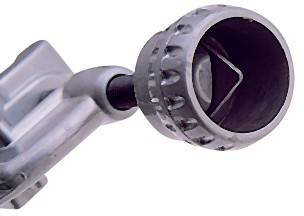
Disadvantages: Rather than cutting the pipe, it "breaks" it through metal fatigue. During that process it crushes the pipe end inwards, creating a serious internal burr and distorting the pipe form. It can be used only on thin-walled pipes and low-precision work.
3. Saw-type cutters (band saw, reciprocating saw)
Advantages: Versatile for cutting different materials.
Disadvantages: Making an exactly 90-degree cut is almost impossible, especially on large diameters, because the saw blade flexes. Because the cut vibrates, a smooth surface cannot be obtained and it leaves burrs.
4. Orbital pipe cutting (cold cutting technology) — the professionals' choice
This technology is based on the machine rotating 360 degrees around the pipe and cutting by removing chips with a cutting blade. It is effectively a pipe turning operation.
- Advantages:
- Mathematical precision: Gives a perfect, exactly 90° square cut every time.
- Zero burr: Because it cuts by removing chips it leaves no burr inside or outside the pipe. No cleaning is needed after cutting.
- Cold cutting: It generates no heat and throws no sparks. It preserves the metal's molecular structure and is the safest method for flammable environments.
- A distortion-free result: Because it applies no external pressure to the pipe, it causes no crushing or distortion even on the thinnest-walled pipes.
- Disadvantages: The initial investment cost is higher than for simple hand tools.
7 Critical Questions for Choosing the Perfect Pipe Cutting Machine
Now that you understand the technologies, it is time to ask the right questions to establish your own project's needs.
| The question you should ask | Assessment |
|---|---|
| 1. Which material will you cut? | Sensitive materials such as stainless steel and Inconel absolutely require cold (orbital) cutting. Orbital cutting also gives the highest-quality result on carbon steel. |
| 2. What is your pipe diameter and wall thickness range? | Make sure the machine you choose comfortably covers the diameter and wall thickness range you work in most often. Thick-walled pipes require a powerful machine with high torque. |
| 3. How much precision do you need? | If you are in a high-technology sector such as food, pharmaceuticals or aviation, no method other than orbital cutting is acceptable. Even in general pipework, orbital cutting improves the quality and speed of the work. |
| 4. Does portability matter to you? | Are you working on site or on an existing line? Then you need a light, compact machine that can be mounted easily on the pipe. Larger, stationary models can be considered for a workshop environment. |
| 5. Will you chamfer (bevel) after cutting? | Chamfering for welding is essential on thick-walled pipes. Some advanced orbital machines cut and chamfer at the same time and save you an incredible amount of time. |
| 6. What is your budget and your return on investment (ROI) expectation? | Look beyond the initial purchase cost. Calculate the cost of an expensive stainless pipe scrapped because of faulty cuts and of the labour hours spent on extra grinding and correction. |
| 7. What are your safety standards? | If you work in environments where sparks are forbidden, such as refineries and chemical plants, cold-cutting orbital machines are your only safe option. |
Why Are GBC Orbital Pipe Cutting Machines the Industry Standard?
When you have answered all the questions above you will see that the road leads to professional orbital cutting solutions. And in this field the Italian giant GBC (G.B.C. Industrial Tools S.p.A.) has been setting industry standards for more than 30 years.
- Italian design and superior engineering: GBC machines have a robust, reliable construction designed to work trouble-free for years even in the harshest site conditions.
- Expertise in "cold cutting" technology: GBC offers all the advantages of orbital cutting (precision, burr-free results, safety) at the highest level. Its machines make perfect cuts without disturbing the structure of the metal, even on the most sensitive materials.
- A modular, wide product range: From small pipes a few millimetres across to huge pipelines metres in diameter, there is certain to be a GBC model to suit every application and every pipe diameter.
- Integrated solutions: One of GBC's greatest advantages is offering models that can both cut and chamfer (bevel) on the same machine. That lets you finish the job in a single set-up rather than two separate operations and multiplies efficiency.
- User-focused design: GBC machines are designed with the needs of professionals working in the field in mind. Easy set-up, fast adjustment mechanisms and safe working principles come first.
Pipe Cutting Machine Prices: Understanding Your Investment
Yes, the price of a professional orbital pipe cutting machine is higher than that of a simple cut-off saw or lever cutter. But that is like comparing the price of an apple with the price of a car. To understand the real cost you should look at the big picture:
- Every pipe you cut "right first time" with a GBC machine prevents material waste.
- It removes the labour hours spent on deburring and grinding.
- Perfectly fitting pipe ends shorten welding time and improve weld quality.
- It lets you spend less on consumables (grinding discs, saw blades and so on).
- It increases workplace safety and prevents potential accident costs.
When these factors come together, a quality orbital cutting machine is an investment that pays for itself in a very short time in a professional business and then starts to earn money.
Conclusion: Your Cut Quality Determines Your Project's Fate
Pipe cutting is the first and most critical link in the pipeline fabrication chain. The weaker that link, the weaker the rest of the chain. If you aim for the highest quality, safety and efficiency in your projects, you have no luxury of compromising on cut quality.
Although there is a "cutting" solution on the market for every budget, professional results are obtained only with professional tools. Orbital cutting technology, which brings together the principles of burr-free, square, distortion-free and cold cutting, and its leading brand GBC, are the right and the most profitable choice for every professional who does not want to leave their work to chance.
Choose the right GBC pipe cutting machine to lay your project's foundation soundly, take your weld quality to the next level and increase your efficiency over the long term. Our expert team is ready to help you find the solution best suited to your project's needs.