
Bipolar Plate Straightening
In the production of metals and in their further processing, residual stresses are introduced. With very thin material thicknesses, as is the case with metallic single and bipolar plates, these residual stresses become particularly visible, and the complex three-dimensional geometry of the plates leads to a further asy…
Bipolar Plate Straightening
Specifications / Models
Machine concepts
On the basis of the following machine concepts we find the optimum solution for you:
More efficient and economical stacks through straightening
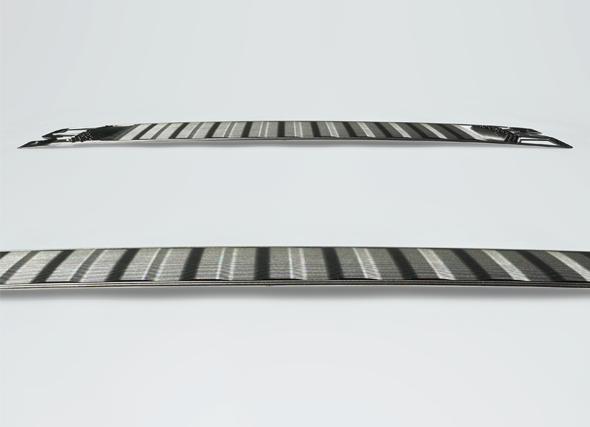
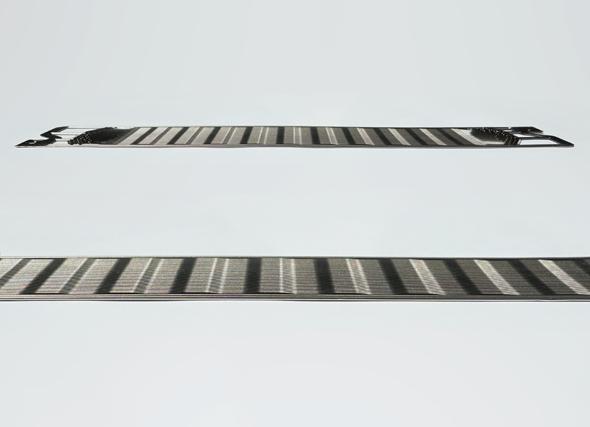
For use in fuel cells and electrolyzers, metallic single or bipolar plates are stacked and pressed together in stacks of sometimes several hundred plates. In addition to the plates, extremely flexible and sensitive components such as membranes, gas diffusion layers and seals are also installed.
If the plates are not flat but warped, this leads to an inhomogeneous distribution of pressure between the components when a stack is pressed together, which has a negative impact on the effectiveness and durability of the stack. If the resulting transverse forces are too great, this even leads to microcracks in the sensitive components, and total failure of the stack can occur.
Warped plates also reduce the overall economic efficiency of stack production, as they require more effort in all processes following the welding process, i.e. in seal testing, post-coating, seal application and stacking.
Highest quality with full flexibility
With our specially developed and worldwide unique technology for straightening metallic single and bipolar plates, these residual stresses can now – depending on the geometry – either be significantly reduced or even almost completely eliminated.
Our technology is designed in such a way that the straightening process is contactless. Thus, it neither influences the surface and a possible coating nor the moulded geometry of the metallic plates. Furthermore, our technology can be used for all metallic single and bipolar plates, without geometrical restrictions in the X and Y directions.
For the first time, the Graebener® straightening machine enables you to produce flat plates – a necessary requirement for both economical stack production as well as high performance and durability of the stacks.
Our machine can be operated either as a single machine or as part of a fully automated production line. Thanks to our in-house production laboratory, we determine the corresponding process parameters in advance in a prototyping.
Source: the manufacturer's product page
Product Description
In the production of metals and in their further processing, residual stresses are introduced. With very thin material thicknesses, as is the case with metallic single and bipolar plates, these residual stresses become particularly visible, and the complex three-dimensional geometry of the plates leads to a further asymmetrical distribution
- showing up as warping or deviation from an ideal flatness.